Traditional vs. Digital Patient Recruitment: Where to Put Your Budget
A practical look at when legacy outreach still wins and where digital channels scale faster for clinical trial enrollment.
The Recruitment Budget Question Every Sponsor Faces
At some point in study planning, someone in the room asks the question out loud: should we spend this recruitment budget the way we always have, or is it time to shift more dollars toward digital? It's a fair question, and the honest answer is that it depends on your study — but the landscape has shifted enough that every sponsor, CRO, and research site should be thinking about it deliberately.
This isn't about chasing trends. It's about matching your outreach strategy to where your potential participants actually are, and understanding what each approach can and can't do.
What Traditional Recruitment Still Does Well
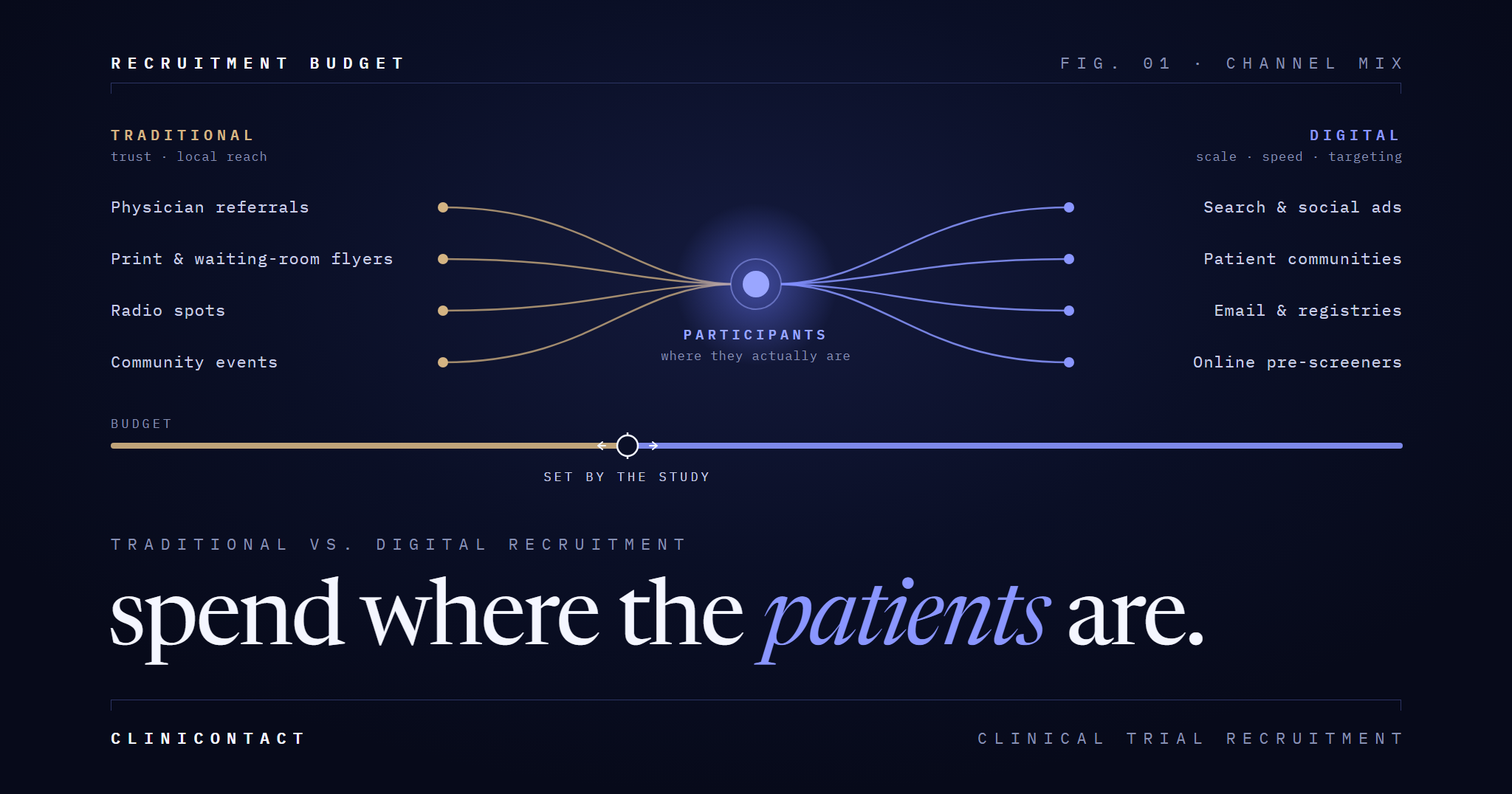
Physician referrals, print advertising, flyers in waiting rooms, radio spots, and community health fairs have been the backbone of patient recruitment for decades. They didn't survive this long by accident.
For studies targeting older populations, people with limited internet access, or conditions tightly managed within specific clinical networks, traditional channels can still generate some of the highest-quality referrals. A patient who hears about a trial from their own doctor arrives with a built-in level of trust and context that's hard to replicate through a digital ad.
Community outreach also matters in populations where distrust of research institutions runs deep. A presence at a local event, a partnership with a community organization, or a printed brochure in a familiar clinic can open doors that a Facebook ad simply won't.
The real limitation of these methods isn't reach — it's measurability and speed. Traditional outreach is often difficult to track with precision, can take longer to ramp up, and doesn't offer the same ability to adjust quickly when something isn't working.
Where Digital Marketing for Clinical Trials Scales Faster
Digital marketing for clinical trials has matured significantly. Paid social media, search advertising, pre-screener landing pages, and targeted display campaigns can reach large audiences quickly, and — crucially — every step can be measured.
This measurability changes the budget conversation. When you can see how many people clicked, how many completed a pre-screener, and how many converted to screened participants, you can optimize in real time. You can pause what isn't working and double down on what is. That kind of responsiveness is simply not possible with a print run or a radio buy.
Digital channels also open up geographic flexibility. If a site in one city is struggling to enroll while another has capacity, digital campaigns can be adjusted to drive more traffic where it's needed — something that would require reprinting materials and renegotiating placements in a traditional model.
For studies with broader eligibility criteria or conditions with large patient communities online, digital can fill the funnel faster than almost any offline method. Condition-specific communities, patient advocacy groups, and health-focused platforms mean that highly motivated, already-informed potential participants are reachable at scale.
When the Best Answer Is Both
The most effective recruitment strategies rarely rely on a single channel. A sponsor running a rare disease study, for example, might lean heavily on physician networks and specialist referrals while simultaneously running targeted digital campaigns to reach the small percentage of patients who are actively searching for options online. The two approaches reinforce each other.
For more common conditions with larger patient populations, digital can carry more of the weight — but community trust-building through traditional outreach may still be essential for certain demographics or geographies.
The budget allocation question, then, isn't really traditional versus digital. It's about understanding your protocol, your population, and your sites — and building a media mix that reflects that understanding rather than defaulting to habit.
Questions Worth Asking Before You Allocate
Before locking in a recruitment budget split, it helps to work through a few honest questions:
- Who is the participant? Age, health literacy, internet use, and relationship with the healthcare system all shape which channels are likely to reach them.
- How specific is the eligibility criteria? Narrow criteria often favor physician referrals and specialist networks. Broader criteria can open up digital channels more fully.
- How fast do you need to enroll? Digital campaigns can launch and iterate quickly. Traditional outreach often requires more lead time.
- What can you measure? If you can't track it, you can't improve it. Make sure your strategy includes channels where you can actually see what's working.
- What do your sites need? Recruitment support that doesn't match a site's capacity or workflow creates friction, not enrollment.
Finding the Right Partner for Your Study
Whichever channels make sense for your protocol, the groundwork is the same: a clear strategy, the right tools, and outreach that respects both participants and the research process.
CliniContact works with research sites, sponsors, and CROs to build recruitment and enrollment strategies that reflect the actual needs of each study — combining digital marketing for clinical trials with community and site-level outreach where it makes sense.