2026 in Review: What We Saw in Clinical Trial Recruitment
Patients were willing. The front door, the screener and the media plan decided the year.
The short version
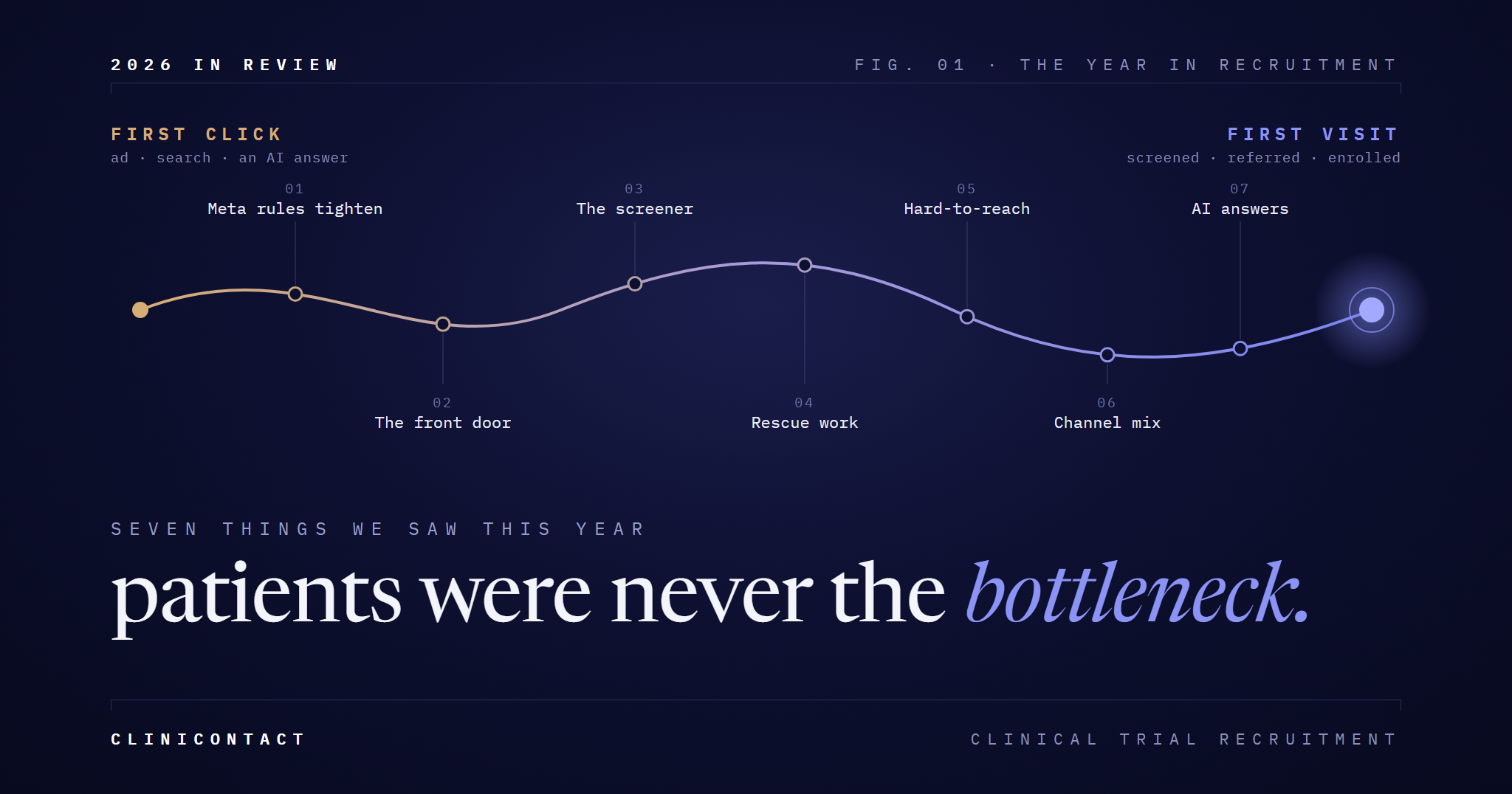
In 2026, patients were not the bottleneck. The front door, the screener and the media plan were. That is the one sentence we would take from a year in which we built recruitment programs for more than 50 studies.
This post looks back at what we saw. It draws on two sources: the studies that came through CliniContact this year, and the questions sponsors, CROs and sites brought to us. Where we have written about a theme in depth during the year, we link to that piece so you can go deeper.
It is a long read. If you only have two minutes, read the seven trends and the section on 2027.
Seven things we saw in the market
1. Meta got harder for health advertisers, and cheap leads got more expensive
The biggest change of the year happened inside the largest paid channel. Meta now sorts any advertiser linked to medical conditions into a restricted category. Custom audiences that hint at a condition get switched off, Advantage+ automation is on by default, and tracking after the iOS privacy changes leans on modeled conversions.
Put together, the platform is very good at finding the cheapest version of whatever event you ask for. Ask for form fills and you get people who fill in forms, not people who qualify. Teams that kept optimizing for cost per lead saw volume hold up while enrolled patients fell.
Our answer was to stop choosing the audience and start choosing the outcome: optimize for the screened, eligible referral and let the algorithm find people who look like that. We explained the full reasoning in When you can't choose the audience, choose the outcome.
2. Patients were willing. The front door was the problem
We kept hearing that a condition was "too hard to reach". Then we kept seeing the first referral arrive within hours of launch. An Alzheimer's trial in London had its first referral four hours after go-live. A stroke study in London took ninety minutes. A study for deaf and autistic children in Miami had its first referral in four hours and a family enrolled by the next morning.
The interest was already there. What lost people was a sign-up that felt like paperwork, or a wait for a human that ran into days. Before adding sites or budget, look at how many questions someone answers before they feel like a person, and how long before someone calls them back. We wrote about those three launches in Willingness was never the problem.
3. The ineligible rate is data, not a verdict on the ad
A high ineligible rate is usually read as bad targeting. On one depression study with a brain scan, 421 women completed our screener and 95 were ruled out. Only 5 of those 95 were ruled out because they had not been depressed in the right time window. The rest hit the protocol: 34 for medical reasons that stopped the scan (metal implants, a dental retainer, an IUD), 27 for distance from the site, 20 for past substance use, 14 for childhood experiences outside the study's groups and 7 for age.
The advert did its job. The protocol did the filtering. Knowing that about 23 in every 100 screeners will not qualify on a protocol like this one lets a sponsor plan the budget honestly, instead of blaming the media. Read Ineligible doesn't mean the advert failed for the full breakdown.
4. More of the work was rescue work
Around 80% of studies miss their original enrollment timelines, and this year more of the calls we took were from teams already behind. The ask had changed from "help us plan recruitment" to "we have weeks, not months". Rescue needs a different playbook: find where the funnel leaks first, fix the screener and the handoff, and only then add media.
We covered how to pivot a stalled study in Finding participants for research fast: rescuing a stalled trial, and how to judge a rescue partner in Best study enrollment rescue services for trials behind on targets.
5. Hard-to-reach populations became the core of the business
Depression, addiction, autism, newborns, adolescents, Native Hawaiian and Pacific Islander families, stroke survivors. These are the groups the industry calls hard to reach, and they made up most of our year. What worked was respect, plain language and a short first step, not a cleverer audience.
Our checklist for recruiting hard-to-reach research participants is the practical version. 3 critical barriers to recruiting for research covers why these studies stall, and How to find participants for research studies is the guide we send to coordinators starting from scratch.
6. Budgets moved from "digital or traditional" to "which mix"
Fewer sponsors asked whether to spend on digital. More asked how to split a fixed budget between physician referrals, community outreach and paid media. Digital scales fastest and is the easiest to measure. Community outreach reaches people that ads never will, and it builds the trust that stops a referral from going cold. The right split depends on the condition, the population and how many sites you have.
This is why we run Horizon for digital recruitment and Bridge for community outreach side by side. We set out the trade-offs in Traditional vs. digital patient recruitment: where to put your budget.
7. Buyers wanted to see the price and the process up front
The market for recruitment help is crowded and hard to compare. Sponsors told us they could not tell a media agency from a patient registry from a site network. We answered by publishing our pricing and naming the five kinds of recruitment company, with examples of each, in Clinical trial recruitment companies: the five types and how to choose.
Speed to launch mattered as much as price. IRB-ready materials in 9 days, with 86% approved on first pass, did more to shorten timelines than any media tactic. The rest of the toolkit is in 9 strategies to accelerate patient enrollment for clinical trials.
What sponsors, CROs and sites asked us for
Academic investigators were our largest group of clients this year. University teams running depression, autism, newborn imaging and exercise physiology studies came to us with a funded protocol, an IRB and no recruitment budget line big enough for an agency. They asked for three things: materials their IRB would approve the first time, a screener that did not waste coordinator time, and a monthly price they could put in a grant report.
Research sites and site networks asked a different question. They wanted to fill the studies they had already won, often several at once, and to show sponsors a steady referral flow. For them the value was in the handoff: a pre-screened referral, with the reasons logged, arriving in the coordinator's queue the same day.
Sponsors and early-phase units, including work in the UK and Germany, asked us to prove a market before committing. Will patients in this city respond? How fast? At what cost per screened referral?
Across all three, the same request came up again and again: tell me early when a study will miss, and tell me why. That is the request we built the year around.
What we expect in 2027
Cost per lead will stop being the number that matters. As platforms automate more of the targeting, the lead count will keep looking healthy while quality drifts. The teams that do well will report cost per screened, eligible referral and cost per randomized patient, and they will feed those outcomes back to the ad platforms.
The screener will become a planning tool. Ineligible reasons, logged from the first week, tell a sponsor which criteria are costing the most. Expect more protocol amendments to be argued with recruitment data rather than site anecdotes.
Speed to first referral will be a standard question in vendor selection. If a partner cannot show referrals within days of launch, sponsors will ask why.
Digital and community outreach will be bought together. Paid media finds people fast. Community partners keep them engaged and reach the ones ads miss. More budgets will be built as one plan with two channels.
Patients will ask an AI before they ask a coordinator. More people now learn about a condition, a treatment or a trial from ChatGPT, Gemini or a Google AI Overview. KFF's tracking poll found that 29% of US adults used AI tools for health information at least once a month this year, up from 17% in 2024. What those answers say about a study, and whether it is right, will shape who reaches the front door at all. In our own checks, most wrong answers came from old pages that were never updated, not from the AI making things up. We explain what to do about it in What AI tells patients about your trial.
If 2026 proved anything, it is that the patients are out there and willing. 2027 is about making the path from the first click to the first visit shorter, kinder and easier to measure.